

18 Feb Global Plan Leadership for the 21st Century
Global Plan Leadership for the 21st Century
by BILL GREEN
2021
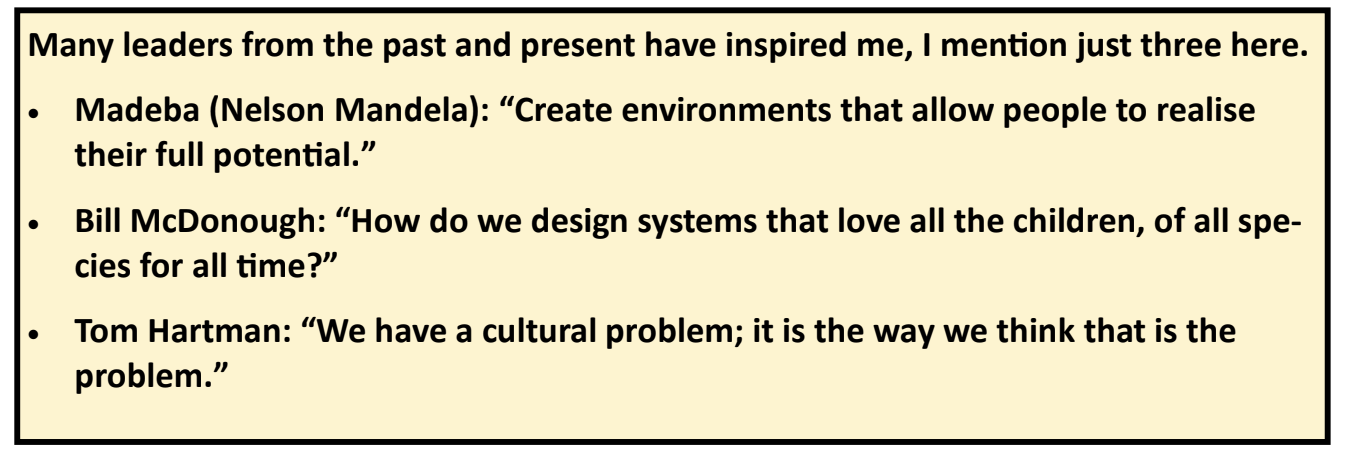
One of the most important qualities of a good leader, I think, is the ability to recognize and pursue the right goal or goals. A good leader needs wisdom, so what is wisdom and how do leaders acquire it?
We know that Steve Jobs actively sought wisdom (enlightenment) for many years before cofounding Apple Inc. He explained that the outstanding success of Apple was founded on collaborative teams within the organisation. Steve set a goal for Apple to “provide customers with an amazing experience.” Some amazing technology was required to provide that amazing experience, but the technology was not the goal.
Steve’s wisdom was also revealed in the house rules he (and I expect his wife) made for their family: ‘No screens in the bedroom or at the dinner table.’ Although Steve could be a difficult person, he was wise to protect these spaces from the intrusion of disturbing news and endless distraction, they made the bedroom and the dinner table feel like sacred spaces, honouring the need for quiet reflection, restful sleep, and family connection and conversation–so
important to family and individual health.
Ultimately, I believe, we are led by principles. Good leaders who truly care for the people identify the principles that will serve the people, and explain them.
Wisdom could be defined as knowing what is important–and what is most
important to be doing in any particular moment or circumstance.
It is not uncommon in my experience for employees, particularly employees of a large organisation, to give little thought to the overall purpose of the organisation or to neglect considering the wider effects of its activities on nature, wellbeing, equity, and the quality of human experience. Too often, they fail to think beyond career advancement, shareholder value, and profit. Where is the concern for the wellbeing of society as a whole, on universal wellbeing, and for human-Earth wellbeing?
A court in Holland recently ordered Shell to reduce its greenhouse gas emissions by 45% below 2019 levels, by 2030. The court said that Shell violated basic human rights, particularly “the right to life and a secure family life” by not reducing its emissions. To comply with the court order, Shell will have to rethink its purpose and operations.
Our collective dream, if there is one, is not clear at this time, although I have a sense that a shared dream is emerging as we connect with each other. Our dreams are mostly individual and in competition with others. Rights are asserted more often than responsibilities are recognised. There is no dream that I am aware of that would unite us, that wouldcombine our talents, energy, and goodwill to create a society and a way of life that would inspire and satisfy most people.
Wendell Berry observed that early European settlers on the Great Plains had “vision but no sight.” Desperate to escape poverty and oppression and lacking the knowledge we have today, they tried to impose a dream on a land they did not understand. That forgivable lack of understanding led to heartbreak in the Dust Bowl of the 1930s.

Past dreams were built on the assumption of a boundless Earth. Today we are confronted with the reality of limited space and resources and a huge growing human population aspiring to lifestyles that the Earth cannot sustain. A truly global vision is now called for, one focused on growth in the quality of every life experience.
Jeremy Rifkin has said that our global vision needs to be “compelling” to be effective. Thomas Berry called for a vision that is “enchanting.”
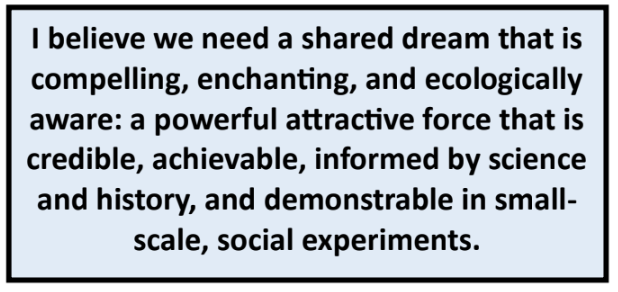
We need a force powerful enough to draw human energy and talent away from the unsustainable, destructive, hope-destroying path that we are presently on. The thought of it takes my breath away, but I do believe that such a vision will be an essential part of the process of healing and repair, and beyond that a new era of human and ecological health, growing out of connection, awareness, and responsibility.
Edward O. Wilson suggests that half the Earth’s surface will have to be set aside to allow nature to sustain itself in health and be productive enough to support the needs of up to eleven billion people, expected by 2100. It seems to me that land-use policy needs to become a hot topic of conversation.
I believe that we need a global plan now that will inspire confidence in people, regardless of cultural, political or ideological differences, so that even if the goal seems far off, we can begin to align present actions at every level and scale with the goal of sustainable human-Earth wellbeing. What matters now is that we feel confident that we are moving in the right direction and so maximise energy and commitment to the goal. I recognise that many people and groups are taking and have already taken important actions, at considerable cost to themselves, that move us towards a sustainable human presence on the Earth.
What will it take to provide for the needs of up to eleven billion people, so that they are able to live healthy, fulfilling lives on a finite planet (accepting that climate change and pandemics could reduce populations substantially)?
A preliminary concept plan could achieve some important objectives:
⇒ Indicate the size, scope, and complexity of the task as a first approximation.
⇒ Stimulate imagination in a shared consciousness-expanding activity.
Following the advice of Bill Gates, Steve Jobs, Bill McDonough, and Larry Page, it is important initially to play with ideas, to approach the subject lightly and have fun before applying rigour, to avoid feeling overwhelmed.
⇒ Provide an overview of the many complex interacting systems that will be the subject of the plan.
⇒ Indicate the direction and focus of research that will precede detailed development of the plan.
⇒ Help to shape the purpose and content of education for the transitions and beyond.
⇒ Be a means to achieving consensus that would point the way to unity. (Note that trade between nations was once regarded as a path to peace but failed because ideological differences remained and trade is fundamentally competitive. Trade wars and violent conflicts over access to resources are evidence of this failure.)
⇒ Allow interested individuals and teams to identify a role for themselves in the process.
⇒ The plan could highlight values and attitudes that create order and disorder in the world, harmony and conflict, abundance and waste, beauty and ugliness.
The plan would be grounded in Earth realities: The Earth is finite. The ecosphere is complex and inter-dependent, and a product of nature’s laws. Earth realities are what Aristotle called first principles: they are verifiable facts, unlike ideologies that can be arbitrary (such as neoliberalism, for example, which is primarily concerned with the distribution of financial wealth rather than the wellbeing of people and the biosphere).

Among Earth realities is the fact that justice and fairness are essential to harmonious human relationships and goodwill. Intergenerational equity is the responsibility and natural right of every generation.
Carefully assembled multi-skilled collaborative teams will be needed to develop the global plan.
We need to begin imagining at global scale–seeing in our mind’s eye the Earth in all its dynamic complexity and beauty. With the help of science and technology, our mental models will gradually change as they transform towards congruence with Earth realities.
The plan begins with consideration of the context: the whole Earth, atmosphere, land, oceans, and human activities and aspirations.

Order can emerge from chaos:
Nature creates order out of (apparent) chaos. Consider the formation of our solar system: A vast cloud of gas and dust that contained all the elements essential to life collapsed on itself and began to rotate under the influence of gravity. Increasing density and pressure at its core caused nuclear fusion to begin, and our sun was born in brilliant yellow light. Beyond the sun, swirling gas and dust continued to condense and coalesce in violent collisions. Over eons, temperature declined and a veil of dust waslifted, revealing eight unique planets and their moons, orbiting the sun with the regularity of a clock. I like to think of this magical process because it gives me hope that the conflicts on Earth may eventually resolve into something beautiful.
Earth realities:
The global plan would describe the deep foundations of wellbeing: dynamic, evolving, life-supporting foundations that facilitate the ongoing expression of human and ecological potential. The foundations of sustainable human-earth wellbeing are an integration of human activity with nature’s life-support systems.
Earth realities as principles:
The Earth is finite and has only one abundant source of energy in the form of sunlight. Meanwhile, human population approaches eight billion in 2021.
People aspire to wealth: a standard of living measured in terms of increasing material possessions rather than health and a rich life experience supported by an elegant sufficiency of material things.
The plan would include preparedness for major disruptive events, such as epidemics and extreme weather magnified by global warming.
Preparation for the transition to human-Earth well-being.
A challenge of such magnitude and complexity requires the most careful, calm, and thorough preparation (even as we acknowledge the urgent need for action), beginning with an accurate understanding of the present state of our culture and society. It also requires an accurate description of the multiple difficulties we face and their causes.
In meeting what many of us perceive to be the greatest challenge humanity has ever faced, we will grow as individuals and as closely cooperating creative groups. We may even discover abilities and sensibilities that we were not previously aware of. We don’t know how difficult the transitions will be until we try. The ongoing struggle for action to reduce emissions of greenhouse gases after warnings from scientists more than thirty years ago is a sobering reminder of how difficult it can be to change just one element of a complex society.
The global plan is the foundation on which the best of human design can flourish, reaching beyond the great art, engineering, and architecture of the past. Industrial ugliness would gradually be replaced by the highest and best in human creativity in a new aesthetic for the ecological age, expressed as beauty, diversity, and grace.
Bill Green is a generalist in an age of specialization. His work focuses on social-ecological wellbeing as a means to fulfilling prosperity that sits comfortably with a finite planet straining to support a huge human population. He has sought to gain a non-specialist’s appreciation of disciplines: physical sciences, politics, government, economics, systems thinking, culture and design.
His unpublished book is: The order Essential to Life; design for wellbeing in the twenty-first Century.