

18 Feb Alexander And The Sadhu: The Space for Conscious Leadership
Alexander And The Sadhu: The Space for Conscious Leadership
by LYNDON REGO
2021
A long, long time ago in a place far, far away, there was a fabled encounter between two strangers. It is an encounter that illuminated an important insight about leadership for me.
When I was young, I associated leadership with many things that weren’t very good — unfettered power, ossified hierarchy, and endemic corruption. Later, I began to see leadership as independent of what it is used for. I recognized that many people who created great good in the world were remarkable leaders. The difference wasn’t their leadership ability but what guided their leadership. The old sto ry I had heard shed light on this difference.
The story was about Alexander the Great and a sage in India. Alexander’s army had fought their way from Greece through the Middle East and through the rugged mountains of Afghanistan. The remnants of the exhausted Greek army finally trudged into the fresh green fields of India where they encountered many unfamiliar sights.
One of them was a sadhu — a naked sage who had renounced the world — sitting in solitary and blissful meditation under a tree by the road. Alexander at the head of his army stopped, and through a translator, asked the man: “What are you doing?” The sage looked at Alexander and his long line of battle worn troops and asked in return: “What are you doing?” Alexander thumped his chest and proclaimed: “I am conquering the world!” The sage stroked his beard and smiled and said: “I too am conquering the world!”
Alexander was conquering the external world, through force. The sage was conquering the inner world through quiet inner reflection. Alexander was using his leadership skills to exert his will on the world. The Sadhu was using his will to focus on self-mastery and had little interest in goings-on in the wider world. Leaders who change the world for the better borrow a bit from both Alexander and the sadhu.

Leaders like Gandhi, Mandela, and Martin Luther King Jr. rise to confront injustice in the world but act from deep consciousness. In contrast, leaders like Alexander are courageous but unconcerned about the harmful impact of their actions on those they oppose. The leadership that Gandhi embodied was distinctively different than that of Alexander.
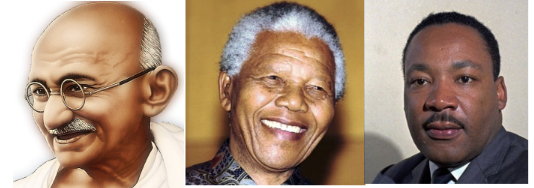
“It was the path of conscious leadership.”
The differences between Gandhi and Alexander are manifested in the layers of Maslow’s hierarchy of needs as well as the Indian system of the chakras and consciousness. At the base level, the orientation is rooted in survival. At a mid-level, it is about succeeding in existing systems. Further up, it is about transforming systems and changing the world. At the highest levels, it is about transcending individual needs for the greater good. As you move up, the focus is increasingly inclusive and integrative.
Einstein spoke to this when he said: “Our task must be to free ourselves … by widening our circles of compassion to embrace all living creatures and the whole of nature in its beauty.”
It is an idea also expressed by Chief Seattle: “Humankind has not woven the web of life. We are but one thread within it. Whatever we do to the web, we do to ourselves. All things are bound together. All things connect.”
Earlier still, the mystic Rumi indicated that what lies within us at the essence is also the essence of the expansive universe. He said, “I am not a drop in the ocean, but the ocean in a drop.”
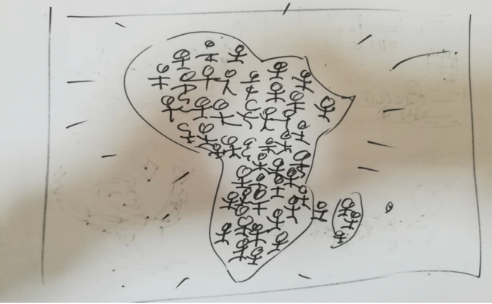
This sense of interdependence is also embedded in the African idea of Ubuntu that recognizes that the whole and the parts are indelibly bound. Ubuntu states: “I am because we are.” These expressions – from North and South, East and West — speak to a universal ideal of oneness.
This approach seeks a way beyond right and wrong, across us and them, and between fight and flight. Alexander embraced the fight and sought to conquer the world. The sadhu opted for a form of flight and non-engagement in the world. An alternate path is what Tara Brach framed as “attend and befriend.” To attend is to lean in and offer attention in order to increase understanding and extend empathy. To befriend is to engage and connect in a way that also serves the other. True friendship, after all, cannot be coerced. It is a form of love.
Great change agents take a systems view that aims higher and reaches across. Arriving at this level of consciousness comes from the inner work of the sadhu; stepping up to change the world takes the courage of an Alexander. Mandela pointed to this link between the inner and the outer worlds. He said, “We can’t change society unless we first change ourselves.” Gandhi, Mother Teresa, Martin Luther King, Mandela and the Dalai Lama all spent a lot of time in quiet contemplation — prayer, reflection, meditation like the sadhu. They did so in order to show up in the world with clarity, courage, compassion, and love.
This kind of conscious leadership represents our highest human potential and creates the widest ripples of impact. Gandhi not only helped liberate India but inspired the efforts of Martin Luther King, Jr. and Mandela who helped liberate millions of people without the great bloodshed that revolutions typically produce. Their example represents the kind of leadership we need to revive and replicate today as our world faces exceptional challenges. We can’t retreat like the sadhu nor force our will on the world like Alexander. The path of conscious leadership calls us to engage with courage and conscience. And to do so, the battle we must first wage is within ourselves.
Lyndon Rego focuses at the intersection of leadership, innovation, and transformation. He has worked in nearly two dozen countries on individual, organization, and community transformation efforts. Lyndon founded CoMetta, an organization working to build community. Earlier, he worked with the African Leadership University, the Center for Creative Leadership, and managed an international social enterprise. He has an MBA from UNC-Chapel Hill and published in MIT’s Innovations journal and Stanford Social Innovation Review.
You can read more of Lyndon’s writing at: http://www.spiritualsushi.com
