

18 Feb Conscious Leadership: Building Culture of Trust and Connection
Conscious Leadership: Building Culture of Trust and Connection
by POYEE CHIU, ROSIE CORVO, JOEL WRIGHT, ANNE HUNNEX
2023
Executive Summary
In a world increasingly shaped by complexity and rapid change, conscious leadership provides a meaningful path forward. This white paper synthesizes key insights from the 2024 Leadership Forum Community (LFC) Summit, exploring themes such as trust, relational culture, leadership development, and the evolving role of technology — particularly artificial intelligence (AI)—in enhancing leadership effectiveness. At the heart of these discussions lies a powerful belief: leadership begins within. Conscious leaders cultivate cultures rooted in empathy, trust, and authenticity—the foundational elements of connection, engagement, and execution.
Introduction
The 2024 LFC Summit continued the exploration of conscious leadership by building on the rich discussions that started within the “Me to We” theme of the 2023 Summit and produced the whitepaper: Building the Collective Capacity for Conscious Leadership. This whitepaper introduced a conscious leadership framework that summarizes how we have come to learn and define conscious leadership. In essence, cultivating conscious leadership is not just about what leaders do—it’s about who they are. This approach emphasizes awareness, intention, and the responsibility we have to take action – ultimately a choice, grounded in self-awareness, empathy for others, and contextual understanding.
One key takeaway from the 2023 Summit was the need to move from leadership theory into real-world practice. The 2024 Summit expanded on this by focusing on how leaders can build a conscious leadership culture—one that is defined by trust, mutual respect, and a deep commitment to the growth of individuals, their organizations, and creating positive change.
What is Conscious Leadership?
Conscious leadership is a mindset and practice that involves being self-aware and considerate of others, understanding the interconnectedness of all aspects of reality, and taking responsibility for the impact of our decisions and actions on individuals, communities, and the environment. Conscious leaders value diverse, inclusive, and authentic expression, and they strive to foster a culture that cares about people and promotes learning and growth. They are mindful of their emotions and interpersonal interactions, seeking to understand themselves and learn from the world to effect positive change. – Leadership Forum Community Poll 2023 Summit
At its core, conscious leadership is about leading with awareness and intention. It’s about being fully present, making mindful choices, and acting from a place of authenticity. This contrasts with traditional leadership models that often overly focus on outcomes, efficiency, and control. Conscious leadership invites leaders to consider not just what they are doing but how they are doing it and, more importantly, why.
At the 2024 Summit, a provocateur used the LFC’s new conscious leadership framework (referenced in the Building the Collective Capacity for Conscious Leadership whitepaper) and facilitated a session, thinking of the framework as a Conscious Leadership Wheel. It introduced the holistic nature of this approach.
The wheel highlights key qualities of conscious leadership: Awareness, Intention and Action. These qualities foster a leadership environment where individuals feel seen, valued, and supported as whole human beings. Empathy, truth-telling, vulnerability, and mutual trust are essential components of this approach. It creates space for intentional thought processes which inform actions that promote a healthy environment for work and community. The Conscious Leadership Wheel is not only a model for developing personal conscious leadership capabilities, it is also a model for building conscious leadership cultures in our organizations.
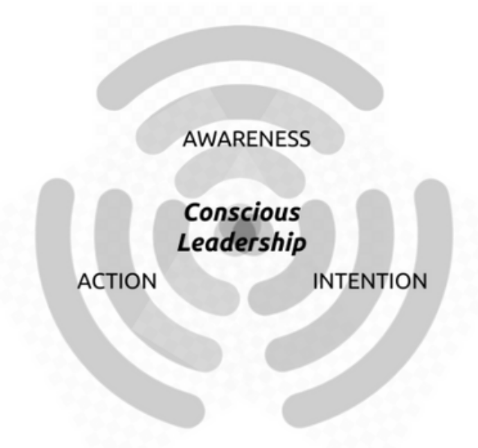
Conscious leadership development is not a linear process. Although it can start with awareness, people can enter this model via other pathways, such as intention, which then generates awareness and action, or action that leads to awareness and intention. Each entry point provides an opportunity to explore the other components and grow in conscious leadership. It is, however, important to utilize all three components. Having action without intention and awareness or having intention without awareness or action will not lead to the desired result of conscious leadership.
Why Conscious Leadership Matters
The importance of conscious leadership cannot be overstated. In today’s fast-paced world people find they are increasingly disconnected. Reports of loneliness and social disconnection are more frequent and are associated with decreased job satisfaction and engagement. This disconnection is where conscious leaders can build bridges of trust and empathy that foster deeper relationships. These essential human relationships are the bedrock of high-performing, engaged teams. Participants in the 2024 Summit repeatedly highlighted the power of authentic connection. As one attendee put it, a conscious leadership culture feels like a “loving culture”—one where individuals are supported, respected, and trusted. Working in a culture of acceptance enhances the productivity and creativity of a team and organization. It results in highly engaged workers who can bring all their talents to the table.
Pre-Summit Hypothesis, Exploration, and Research:
Ideas always abound before a summit—curiosity about the topic, emerging hypotheses, and a hunger to discover new insights. The theme of cultivating conscious leadership cultures felt ripe for exploration.
Ahead of the 2024 Leadership Forum Community Summit, two provocateurs teamed up to interview leaders within a corporate culture they believed exemplified strong conscious leadership traits. Their goal was to better understand what defines a conscious leadership culture—how it looks, how it feels, and the impact it has on people and performance.
Through in-depth conversations with eight senior leaders, they explored foundational questions:
- When did you become a more conscious leader?
- How do individuals define leadership, and how does that differ from conscious leadership?
- What does a conscious leadership culture look like in action? And what examples exist within this organization?
A powerful theme that emerged was the idea of a personal origin story—a defining moment when individuals discovered who they were as leaders and what they stood for. Much like a superhero narrative, these moments marked the beginning of a conscious leadership journey. One senior HR leader shared how, early in their career, they loved the mission of their job but felt stifled by an immature and toxic work culture. Choosing to leave that role was a big and risky decision. Risky because, without a backup plan, how would they pay for student loans and other responsibilities. It proved to be a bold, transformational act of self-empowerment. It fueled their desire to build healthy teams and healthy cultures. She ended up becoming an Organization Development professional. Other participants shared similarly pivotal moments, reinforcing how conscious leadership often arises through misalignment, courage, and deep reflection.
The second major insight came when a leader described their organization’s employee brand in one word: authenticity. Drop the mic. What a powerful and aspirational brand—one that forces you to ask: What does it take for someone to show up as their whole, authentic self at work? The answer: a culture that provides psychological safety to take risks, look or work differently, and challenge norms. It requires deep trust that people will deliver, and strong relationships that support strengths-based collaboration and innovation. Interestingly, humility emerged as a second defining brand trait. Just imagine: a culture anchored in both authenticity and humility. These conditions aren’t just humanizing—they’re the foundation of high performance and quite possibly key elements of a conscious leadership culture.
Insights from this initial exploration would pull through and inform parts of the summit.
Building a Culture Based on Conscious Leadership
Creating a culture rooted in conscious leadership requires more than just effective leadership at the top. It requires a collective effort that is woven into the fabric of the organization. This culture is defined by qualities like empathy, vulnerability, and truth-telling. In practical terms, this means fostering an environment where people feel psychologically safe to be themselves, make mistakes, and learn from them. A conscious leader’s ability to create an environment of trust and openness allows others to bring their whole selves to work.
At the Summit, participants experienced some key components of a Conscious Leadership Culture.
- Self-awareness: Understanding one’s story, worldview, and the impact of frames on perception and experience.
- Relationships: Building trust with others, fostering empathy, curiosity, and non judgment, and creating a culture of inclusion and belonging.
- Intentionality and Action Learning: The importance of intentionality in creating change, and learning through experience and reflection.
Self-Awareness
Developing self-awareness includes understanding various components of personality and thought processes. At the Summit we explored a few concepts to enhance our self-awareness.
What is your origin story?
Self-awareness includes expanding understanding of the world, how you encounter, engage, and influence the world. We all have a history that has shaped who we are, how we think, and how we interact with the world around us. To develop increased self-awareness, leaders were encouraged to explore their own origin story, just as we had with pre-summit interviews, in order to better understand how their past, current, and future values, beliefs, and experiences can inform their worldview.
- Where do you come from?
- What events and people have shaped who you are?
- How does your story impact who you are today and how you interact with the world?
Leaders who are aware of their own biases and viewpoints can adjust their opinions and behaviors to ways that are more relevant to the situation, more productive and inclusive, and less reactive.
What is your worldview?
Our perceptions are influenced by mental models or frames. How we see the world or a particular problem can be described as seeing it through a “frame”. Recognizing these frames allows us to understand how they impact our thoughts, feelings, and behaviors. What we think will happen shapes what we think is possible, and how we act.
Frames allow us to look at both sides of a problem. For example, are we living in a world of resource abundance or scarcity? Are we living in a world based on fear or hope? We need to consider both concepts at the same time to see the contrast and determine our current frame. Can we see the world or problem as ‘both and’?
Relationships
Many of the challenges of our times are relational. Relational in terms of relationships with other humans, but also relational in our interaction with the natural world. Therefore part of the solutions need to address relationships and how we can strengthen those relationships through a culture of conscious leadership.
Viewing Relationships through Frames
Knowing who we are and our frame of the world gives us the foundation to see how someone else might be viewing the same problem. Are they using a different frame and coming to a different conclusion? Unless we can understand our own and someone else’s frame, we can’t have a productive conversation to address the problem. Analyzing frames is a skill that can be developed once you open your eyes to start looking for them. What frame am I in? What frame are they in?
On a cultural level, understanding relationships requires looking at the multiple frames that make up our view of the world and that of others. To add to the complexity, we all live in multiple cultures at once. We have a culture within our team at work, while there might be a different one for the overall organization. We have a culture within our family and within our community. There are also cultures for any other social and religious organizations that we are part of. Each of these cultures includes frames that combine and influence who all of us are and how we approach the world. Beyond the self, recognizing the frames of others helps us become more empathetic and understanding so that we can better communicate and collaborate as we solve problems and work together.
How do we experience trust?
Trust is the cornerstone of healthy relationships, and it is the foundation of conscious leadership. It requires vulnerability, honesty, and reliability. As Paul Martinez, Chief Leadership Strategist, pointed out, “Trust is one of the things that we lack severely in this world, and it is quite foundational to every single relationship you will ever have.”
Trust starts within ourselves. When leaders cultivate trust in themselves, they can extend that trust to others, creating a ripple effect that enhances team dynamics and organizational health. Trusting self is about being confident in our decisions while knowing our strengths and weaknesses. It is about being authentic.
Trusting others acknowledges their value and gives them permission and power to fully use their talents. There is no need to hoard power or resources if you live in a world where there is trust between people. All will contribute to a goal in a way that maximizes resources. Trust allows us to admit weaknesses and mistakes which means that others can step in when needed. It also creates an environment that allows for learning and collaboration.
Creating mutual trust strengthens our relationships and provides a deep sense of human connection and empathy that is needed to build community. Participants in the 2024 Summit repeatedly emphasized the transformative power of authentic connection. Creating connections and a sense of trust and belonging is essential for fostering a positive and supportive work environment.
Beyond trusting people, how do we trust the information we receive from the world around us? Information comes to us through so many sources. People tell us things, whether they are our friends or organizational leaders, or global leaders. We read things in books, in the news, and on social media. We search for information from a variety of sources.
With all this information, how do we know what to trust? We are often looking at the source of information to determine if it is trustworthy. AI has added a new dimension to information where we can’t really determine the source since it is a synthesis of various sources. Because AI is new and unknown we can feel uncomfortable with the information it gives us. Can we really trust it? How can we use AI as a tool and be able to trust it?
If we look at AI as if it were a person, we need to scrutinize the information to determine if we feel it is trustworthy, good information. What we do need to recognize is that AI can be a super smart helper. AI is intelligent and can communicate elegantly. It can notice things that we don’t and point out our blind spots, maybe more truthfully than our coworkers or friends. AI can help us be better at what we do. Our world has expanded so that we not only have to develop relationships with people, but we need to determine how to relate to AI to expand our work capacity.
Belonging
The Summit attendees consistently brought up the importance of belonging in relationships. The basics of truly seeing and connecting with another person with curiosity and openness. Humans evolved through tribal connection where collaboration was essential for survival. We no longer have that strong connection built into our social groups and need to rebuild cultures of belonging. Building a culture of conscious leadership requires leaders to establish an environment where people feel they belong. Belonging means creating a safe space of inclusion, respect, and empowerment. A culture of belonging allows people to be themselves and bring all their talents to the community or workplace. To do this, leaders need to ensure that all people are valued and included and emulate that behavior consistently. Leaders will need to be increasingly self-aware and be willing to initiate and inspire change. Leaders need to move beyond surface-level diversity initiatives to truly integrate inclusivity and belonging into their organizations. By building teams and systems that reflect the diversity of their communities, leaders can create cultures that are not only inclusive but empowering.
Intentionality and Action
- Intentionality to Create Change: Conscious leadership requires intentional effort to create a culture of trust and connection. Setting clear goals and taking deliberate actions are essential.
- Action Learning: Learning through experience and reflection is a powerful tool for personal and professional development.
- Building and Living the Culture: A conscious leadership culture includes many leadership skills. Conscious leadership is not a one-time event but an ongoing practice.
Intentionality to Create Change
Within the Conscious Leadership Wheel, the Intention component is a powerful one. Looking at intention we set a path of making change. At the Summit, we explored the difference between aspiration and intention. Aspirations create the vision that we set for ourselves that we hope to achieve. Aspirations are an expression of our dreams. We need to have dreams, but intentions are the things that we actually intend to get done. To accomplish our intentions, we need to lay out the action steps to achieve our goals. As Mike Morrison and Clint Kofford explained, creating meaningful change means living intentionally every day through clear goal setting and deliberate actions.
One of the Summit participants felt that Intentionality means being proactive rather than reactive. She compared it to the difference between a thermometer and a thermostat. If you set the thermostat to 70 degrees, it’s going to do whatever it needs to do to achieve the intention of 70 degrees. A thermometer just registers hot and cold and then expects us to react. Declaring your intention is like setting your internal dial or thermostat to achieve something.
Action Learning
Some members of the Summit engaged in an Action Learning session, which is learning through experience and reflection. This process of learning-by-doing allows leaders to develop critical skills such as inquiry, decision-making, and problem-solving. As Reginald Revans, the father of action learning, put it,”There can be no learning without action, and no deliberate action without learning.” By tackling challenges head-on in a structured, reflective environment, leaders deepen their understanding of themselves and their teams.
During this session, participants used the power of inquiry. This form of action learning uses one really important rule. The rule is that you can only make a statement in response to a question. In these sessions, you’re only speaking when you’re either asking somebody else a curious question or when you have been asked a question. When answering questions, you can only answer the question that was asked without elaboration. The focus of communication becomes very intentional through listening, formulating questions, and offering information. This means that nobody can boycott the meeting. Nobody can say,”This is what you should do, you should just try this” or give unsolicited advice. The focus becomes on problem analysis and building leadership muscles around inquiry, listening, problem-solving to make decisions and overcome challenges.
Conscious Culture Components
Over the three days of the Summit, attendees experienced many aspects of a conscious leadership culture. They learned about building a culture that embodies:
- Connection Belonging
- Trust
- Empowerment Respect
- Curiosity
- Inquiry
- Communication Authenticity
- Learning
- Safety
- Openness to Change
Being a conscious leader is about building all of these muscles through knowing yourself and understanding others. It is about building relationships and setting an intentional path for making meaningful change. It is not a one-time event. It requires consistent effort to maintain and reinforce the desired culture. Being a conscious leader means being self-aware and then acting with intention every day. Incorporating conscious leadership principles into daily practices is essential. The power of daily intentions and routines significantly contributes to sustaining a conscious leadership culture.
Conclusion
Conscious leadership is about more than just leading others—it’s about leading from a place of deep self-awareness, trust, and empathy. As discussed throughout the 2024 Summit, the journey toward conscious leadership is ongoing and requires intentional practice and reflection. By fostering cultures of trust, connection, and belonging, conscious leaders can not only improve their organizations but also create meaningful, lasting change in the world.
The insights shared at the 2024 Summit invite leaders to reflect on their own journeys, ask deeper questions, and cultivate the qualities that make conscious leadership possible. Some participants saw these insights as transformative as they continue on their leadership journeys. As we move forward, the challenge is clear: to create cultures where trust, empathy, and authentic connection are the norm and where leadership is a collective, relational process.
To expand your learning visit the Conscious Leadership Tree that includes more than 50 resources to facilitate your conscious leadership journey.