

15 Jan From a Transparent RIF to a Surprise RIF
Case Study: From a Transparent RIF to a Surprise RIF
ANALYZING EMPLOYEE EXPERIENCES AND ORGANIZATIONAL IMPACT
by JOEL WRIGHT
in collaboration with the RIF Lab: Bill Jensen, Briana Case, Daniels Akpan, Poyee Chiu, Yordanos Tenaw
September 2025
Executive Summary
What shifts leadership’s approach from a transparent RIF to a surprise one? Would employees prefer a transparent RIF or surprise RIF and what part does uncertainty and trust play? Who bears the burden, emotional and psychological weight when RIFs are implemented?
This case study examines these questions by looking at two contrasting approaches to workforce reductions (RIFs) executed within the same technology organization within 18 months of each other. The first was conducted with complete transparency, the second as a total surprise. Each has their strengths and each has their negative impacts.
Preliminary Findings and Research Implications
Survey data from 14 professionals and interviews with 8 organizational experts indicate that while this early dataset provides valuable signals for conducting a RIF, additional research is needed to validate these findings. Key preliminary insights include:
71% of survey respondents preferred advanced transparency
92% of survey responses suggest living with uncertainty is preferred to living with diminished trust, but the science might suggest otherwise
Past practice predicts future implementation
Adult treatment principle
These initial findings warrant further investigation with larger sample sizes and more diverse organizational contexts to establish more robust guidelines for RIF implementation.
The Context: A Human-Centric Company Changes
ABC Inc. is a US and global technology company that built its reputation on human-centric culture, emphasizing wellbeing, psychological safety, belonging, transparency, and employee development. The CEO and leadership team regularly championed these values, even providing great support to employees during the pandemic. One senior leader went so far as to express they believed the employee brand to be “authenticity.”
Over 18 months, the company implemented two major RIFs using dramatically different approaches, providing a unique opportunity to study the impact that transparency and surprise approaches have on employees, leaders, the culture and the business.
The Case: Two Approaches, Same Organization
First RIF: The Transparent Approach
- Announced during quarterly all-staff meeting by CEO months in advance
- Expressed empathy for how hard this was going to be for everyone and thanked everyone for their contributions
- Explained business rationale: grew too fast, need to change organizational structure to reclaim innovative practices, reduce redundancy, and better connect functional expertise siloed in different business units
- Encouraged employees to do what was necessary for them/their family—if you need to look for a job for financial security or greater certainty, please do so
- Opened the floor for questions
- Ultimately cut 2,000 employees
Second RIF: The Surprise Approach
- Same CEO
- No advance warning to employee population
- Executed via mass email with departing employees being locked out within hours of notification
- Some employees would miss communication and suddenly find themselves locked out
- Complete reversal of espoused values and beliefs
- Cut 1,000 employees and canceled 900 job postings
What the Data Revealed: A Story of Competing Needs
When I started this research, I suspected employees might select transparency over a surprise RIF but wasn’t sure. In part, I believed this because I have a transparency bias. So is this all justification of my perspective? Perhaps, but I hoped it would offer a lens on the preferences of employees—the very people organizations need to partner with to achieve results.
As I began to explore the data and discuss it with others, my awareness grew and I recognized it to be much more complicated than simply choosing transparency or surprise because context truly matters.
The survey data painted a clear picture: 71% of respondents, mostly from ABC Inc., who answered the transparency question preferred transparency ahead of time with leaders communicating why, providing details and fielding questions. Only 1 respondent preferred the surprise approach, while 21% selected “other,” sharing something in the middle, recognizing “it is very situational.”
But the story becomes more complex when we examine what each approach actually costs—both for employees and leaders.
The Tale of Two Approaches: Trust, Uncertainty, and Human Psychology
Living with Transparency: The Adult Treatment Principle
With the transparent approach, trust remained mostly stable because people were informed upfront, had the ability to directly hear from leadership, and could even ask questions. Not surprisingly, when news was shared transparently, uncertainty came into existence and remained until the RIF, when certainty about your livelihood became clear.
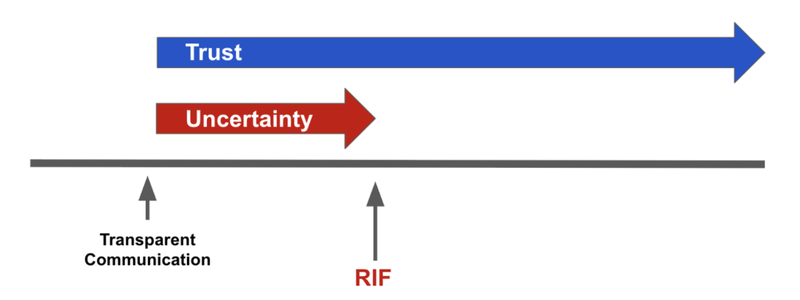
What impacts typify a transparent approach?
- Gives a degree of control back to employees – chose to stay or search for other work (hedge their bets)
- Provides time for emotional processing
- Maintains respect for employees as humans
- Preserves some level of leadership credibility
- Enables relationship maintenance and networking
One seasoned senior leader explained the principle behind this approach: “If we want our employees to act like adults then we need to treat them like adults. They have leases, car payments and so much more. They need to be informed!” This perspective directly contradicts approaches that withhold information to “protect” employees from uncertainty.
Living with Surprise: When Trust Collapses
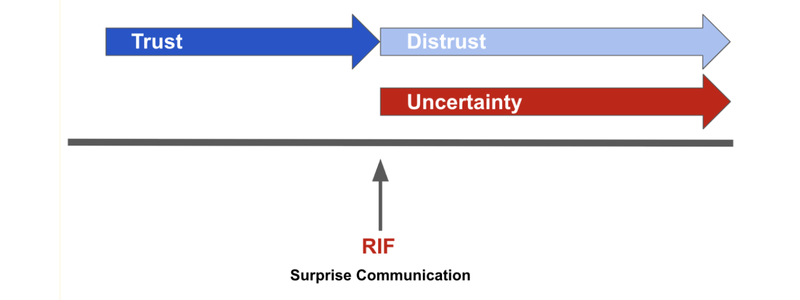
The surprise approach tells a different story entirely. At ABC Inc., trust in the organization had been strong because leadership had previously implemented transparent approaches, explaining context, fielding questions, acknowledging how hard the journey would be. When they implemented a new approach, it really was a surprise, changing the assumed expectation that past practice can often predict future protocol.
What makes this approach so devastating is that distrust and uncertainty start when the RIF happens and can haunt employees, the culture, and company reputation for a long time into the future.
In the book “Healing the Wounds,” David Noer provides evidence about how those who remain in an organization post-RIF can often experience what he named as: layoff survivor sickness. The impacts include:
- Damaged psychological safety
- Anxiety and fear of future RIFs
- Reduced leadership credibility
- Reduced employee engagement and collaboration
- “Everyone for themselves” mentality
Survey respondents who remained after RIFs supported this perspective:
- “Culture of fear and everyone for themselves was a huge shift from the mostly collaborative and kind culture”
- “More guarded. More anxious. Stress.”
- “Continue to feel fear of our roles being eliminated”
- “Continued fear that employment isn’t safe”
One survey respondent noted: “We need to be able to predict or anticipate what might be coming—be it good or bad.” This concern aligns with the Adult Treatment Principle.
The Paradox: What Employees Want vs. What Our Brains Need
When asked directly which they would rather live with while working within an organization, 92% of people preferred uncertainty (Transparent approach depicted in Figure 1 above) over a lack of trust (Surprise approach depicted in Figure 2 above). But this preference raises a fascinating question about human psychology.
David Rock’s research on neuroleadership discovered that our brain responds to social and physical threats in the same way, meaning that the fear we experience when having our life threatened by a bear or large animal can parallel the fear we experience in social settings such as public speaking or challenging others in team meeting. Change is an enormous social threat to humans. In RIFs, where the potential for enormous social changes exists, all five components of Rock’s SCARF framework get triggered: Status, Certainty, Autonomy, Relatedness, and Fairness. (Video for greater explanation)
So what’s the truth? Survey respondents’ conscious wishes or our biologically wired brain that craves certainty?
The Emotional Reality: What Each Approach Actually Costs
To better understand the emotional reaction of those impacted by RIFs, the survey explored emotions triggered when each RIF happened. While the emotions selected were not surprising, it was surprising how many more emotions were experienced with a surprise RIF.
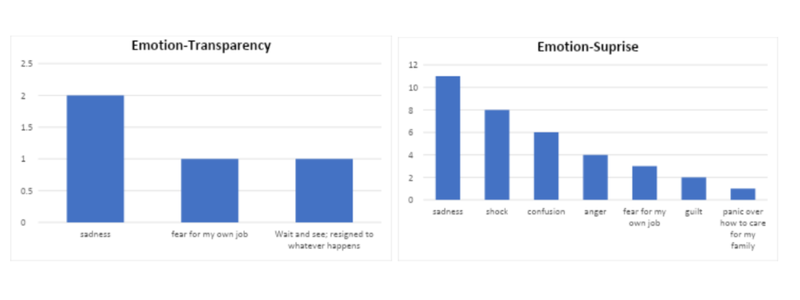
The transparent approach generated fewer intense emotional reactions, while the surprise approach triggered a cascade of emotions simultaneously—shock, sadness, guilt, confusion, anger, and panic over family care.
However, transparency also carries potential drawbacks. Interview participants described the psychological toll of prolonged restructuring processes, where extended uncertainty and repeated organizational changes created sustained distress and eroded morale over time. Just imagine the transparent journey in Figure 1, imagine six RIFs and a reorg taking place within 9 months.
These findings highlight a critical question: How do organizations balance transparency with speed of execution? While transparency reduces the immediate emotional shock of RIFs, drawn-out processes can create chronic stress that may ultimately cause more harm than swift action. Conversely, while surprise RIFs generate intense short-term emotional responses, they can provide the clarity and closure that helps employees move forward more quickly. The challenge lies in finding an approach that honors both the need for open communication, empowering people to be human with each other, and speed to clarity.
The Shared Burden: Why RIFs Are Hard on Everyone
Expert interviews and survey responses confirmed what many might suspect: RIFs are emotionally challenging for everyone involved—employees and leaders alike. One organizational development expert, unaffiliated with ABC Inc., reflected on their own experience leading a transparent RIF at a global pharmaceutical company. They described it as “brutal,” noting that “people constantly gave him feedback about how hard and awful” the process was. This highlights that leaders, who signed up for the difficult job of leading, still feel the weight of these decisions profoundly.
This shared emotional burden helps explain why leadership approaches might shift between RIFs. The ABC Inc. leadership team, having experienced the prolonged emotional intensity of a transparent approach, may have believed that speed to clarity would be more humane for everyone involved. After all, as one expert noted, clarity is what many people ultimately crave.
This tension between transparency and speed isn’t theoretical. I’ve witnessed another organization go through 5 rounds of RIFs because of government funding cuts. Each round tried to achieve a blend of transparency, speed, and improved execution. The organization tried to treat employees like adults, like humans. But as it dragged out with a sixth one coming up, people were nearing a breaking point. One employee said, “just give us clarity, and stop dragging it out”.
This suggests the real challenge isn’t choosing between transparency or surprise, but rather finding ways to provide transparency without prolonging the uncertainty. How do we honor the Adult Treatment Principle while also recognizing that extended uncertainty can become its own form of cruelty?
Questions Needing Further Exploration
- How do we optimize the transparency-speed balance? The 21% of respondents who selected “other” recognized it’s “very situational”—what factors should guide this decision?
- What’s the influence of multiple RIF experiences? Many respondents experienced 2-4+ RIFs. Do people who’ve been through multiple RIFs have different perspectives than first-timers?
- What contextual factors matter most? Organization size, industry, economic conditions, previous trust levels—which variables most influence the optimal approach?
- What’s the true cost of damaged trust? How do you quantify the long-term impact of cultural erosion versus short-term operational efficiency?
- More data needed. What would a larger data set and more interviews suggest about uncertainty and trust preferences across different contexts?
- AI Impact. What role can AI play in helping to better execute RIF plans? How can it reduce periods of uncertainty while preserving transparency benefits?
Conclusion: Providing Grace – The Challenge of Balancing Competing Human Needs
What type of uncertainty does leadership want to manage? Where can leadership provide grace? If both the transparency and surprise approach elicit uncertainty, as shown in figure 1 and figure 2, how does leadership provide grace during one of the most stressful experiences one will endure in their life?
This study reveals that workforce reductions create genuine hardship for everyone involved—employees facing job loss and uncertainty, survivors grappling with guilt and fear, and leaders bearing the weight of difficult decisions that affect people’s livelihoods. Rather than a simple choice between transparency and surprise, the data points toward a more nuanced challenge: how do we honor employees’ need for information and dignity while recognizing the shared emotional toll these processes exact?
The Adult Treatment Principle remains compelling: if organizations want employees to act like adults, they should provide information necessary for life decisions. Yet the research also shows that prolonged uncertainty can become its own form of suffering. The 21% of survey respondents who chose “other,” recognizing that approaches are “very situational,” may point toward the real solution.
The ABC Inc. case suggests that context—organizational history, previous trust levels, economic pressures, and timing constraints—significantly influences what approach serves everyone best. The challenge isn’t choosing between employee preferences and leader comfort, but rather finding ways to provide transparency without unnecessarily prolonging collective anguish.
Perhaps the most important insight is that RIFs test organizational character not through the specific approach chosen, but through the thoughtfulness, empathy, and consistency applied to an inherently difficult situation. Organizations that acknowledge the shared burden, maintain their core values under pressure, and seek approaches that minimize harm to all involved may find that the specific methodology matters less than the humanity with which it’s executed.
The questions raised by this case study point toward a more sophisticated understanding of RIF communication—one that moves beyond either/or thinking toward approaches that can provide both transparency and swift resolution. As one expert observed, the goal isn’t perfect execution but rather finding ways to navigate these challenges with grace, recognizing that everyone involved is doing their best in circumstances no one wants to face.
Future research should focus not on which approach is “right,” but on how different contexts call for different blends of transparency and speed, and how organizations can maintain their humanity while making the difficult decisions that business realities sometimes demand.